What Is a Salvage Title? What 2.26 Million Auction Sales Show
A salvage title is the state's way of saying a car was written off. Our numbers on 2.26 million salvage auction sales show what that means for the price, the car and you.
When an insurer pays out a car as a total loss, the car doesn't disappear. It goes to a salvage auction, usually Copart or IAA, and the state brands its title: salvage. From then on that word is supposed to follow the car through every owner.
We looked at every salvage auction sale in our records from January 2024 to January 2025: 2.26 million cars. Here's what they tell you about salvage titles.
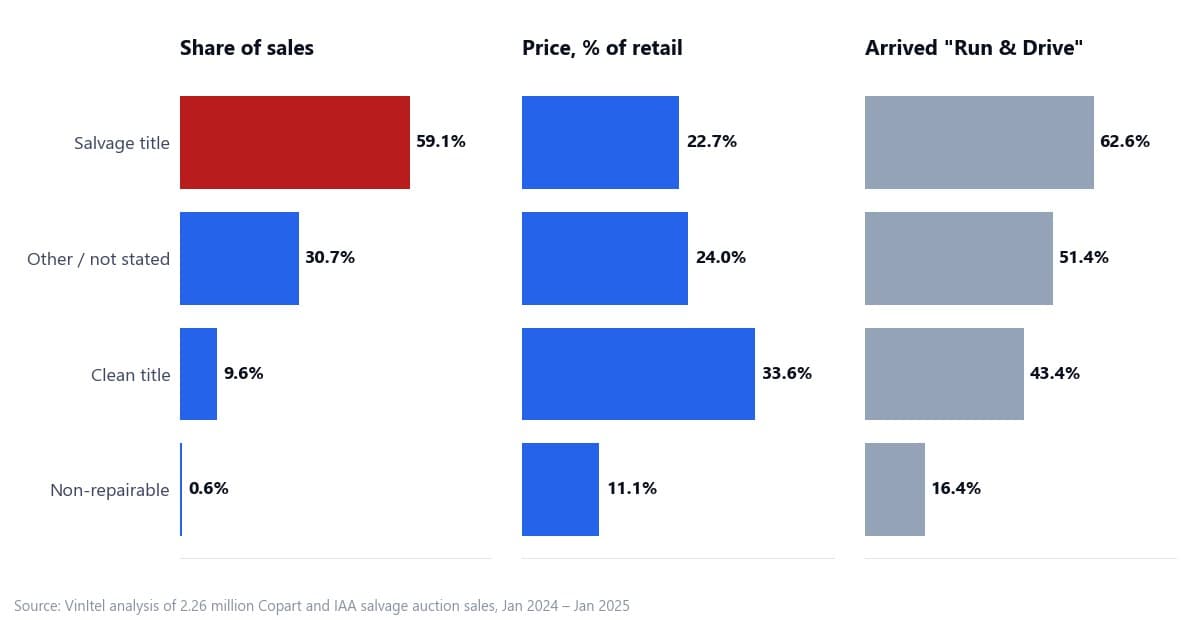
What 2.26 million auction sales show
- 59.1% were sold on a salvage title. That's 1.34 million cars in thirteen months. Another 30.7% sold on other documents, such as certificates of destruction or paperwork the auction didn't specify.
- They sell for under a quarter of retail. Where the auction recorded a retail value, salvage-title cars sold for 22.7% of it on average. The median winning bid was $2,450.
- Most of them still drive.62.6% of salvage-title cars arrived marked "Run & Drive". A salvage brand is about money, not about whether the car moves.
- 9.6% had a clean title. They sold for 33.6% of retail: still cheap, because they were at a salvage auction for a reason. A clean title doesn't mean an undamaged car.
- Non-repairable cars sold for 11.1%. Those are parts cars by law in most states and can never be titled for the road again.
Why a car gets a salvage title
Each state sets its own rule. In many, a car is a total loss when the repair estimate passes a fixed share of its value, often 70% to 80%; in others, when repairs plus salvage value exceed what the car was worth. The usual causes:
- Crashes, mostly front-end. Half of all salvage cars in our data were hit in the front.
- Flood and water damage, which totals cars that look perfect. See how to check for flood damage.
- Hail, fire and vandalism.
- Theft recovery: a stolen car found after the insurer has already paid out.
What happens after the salvage title
- Salvage. The car can be sold, usually at auction, but in most states it can't be registered or driven on public roads.
- Repair. A body shop or a buyer fixes it, ideally with receipts and photos.
- Inspection. The state checks the repair and the parts' origin.
- Rebuilt title. The car can be registered again, but the brand stays on the title for good.
If you're thinking of buying one
- See the damage before the repair. Auction photos show what the car looked like when it was written off.
- Know the damage type. Hail and light cosmetic damage rebuild well; flood, fire and rollovers rarely do. Our rebuilt title data breaks it down.
- Get the repair records and an independent inspection, including a frame and airbag check.
- Call your insurer first. Ask what coverage they'll sell on a rebuilt title.
- Pay a branded-car price. Check what salvage cars actually sell for.
Questions buyers ask
What does a salvage title mean?
It means an insurer or the state decided the car was a total loss, usually because repairs would cost more than a set share of its value. The state brands the title "salvage". In most states a salvage car can't be registered or driven on public roads until it's repaired and passes an inspection.
What's the difference between a salvage and a rebuilt title?
A salvage title is issued when the car is written off. A rebuilt (or reconstructed) title is issued after the car has been repaired and passed the state's inspection, so it can be registered and driven again. The rebuilt brand stays on the title for good, so the car's history is never hidden from the next buyer.
How much is a salvage title car worth?
Much less than a clean one. At salvage auctions in our data, cars on a salvage title sold for 22.7% of their recorded retail value on average. After repair and a rebuilt title, resale values usually stay well below the same car with a clean history, and many dealers won't take one in trade.
Can you insure a salvage title car?
Not while it's salvage: it can't be registered, so it can't be insured for the road. After it gets a rebuilt title, many insurers will cover liability, but some won't sell full coverage, and a payout after another accident is based on the lower value of a branded car.
Is a salvage title car ever a good buy?
Sometimes, for the right buyer: hail and light cosmetic damage often rebuild well, and the discount is real. It's a bad buy if you can't see the damage, the repair paperwork or the auction photos, or if the seller hides the brand. Never pay a clean-title price for a branded car.
About the numbers
Counts come from 2,260,874 salvage auction sales at Copart and IAA in VinItel's records, January 2024 to January 2025, grouped by the title document the auction listed. "Other" covers documents the auction didn't classify as salvage, clean or non-repairable. Price as a share of retail uses only sales with a recorded retail value. State total-loss rules vary; check your state's DMV for the exact law. More on title brands: every title brand explained.
- #salvage title
- #rebuilt title
- #branded title
- #salvage auction
- #car insurance
- #VIN check
- #Copart
- #IAA