Are Rebuilt Title Cars Worth Buying? What 7.5 Million Auction Sales Say
It depends almost entirely on what happened to the car. Our data on 7.5 million salvage auction sales shows which damage rebuilds well and which doesn't.
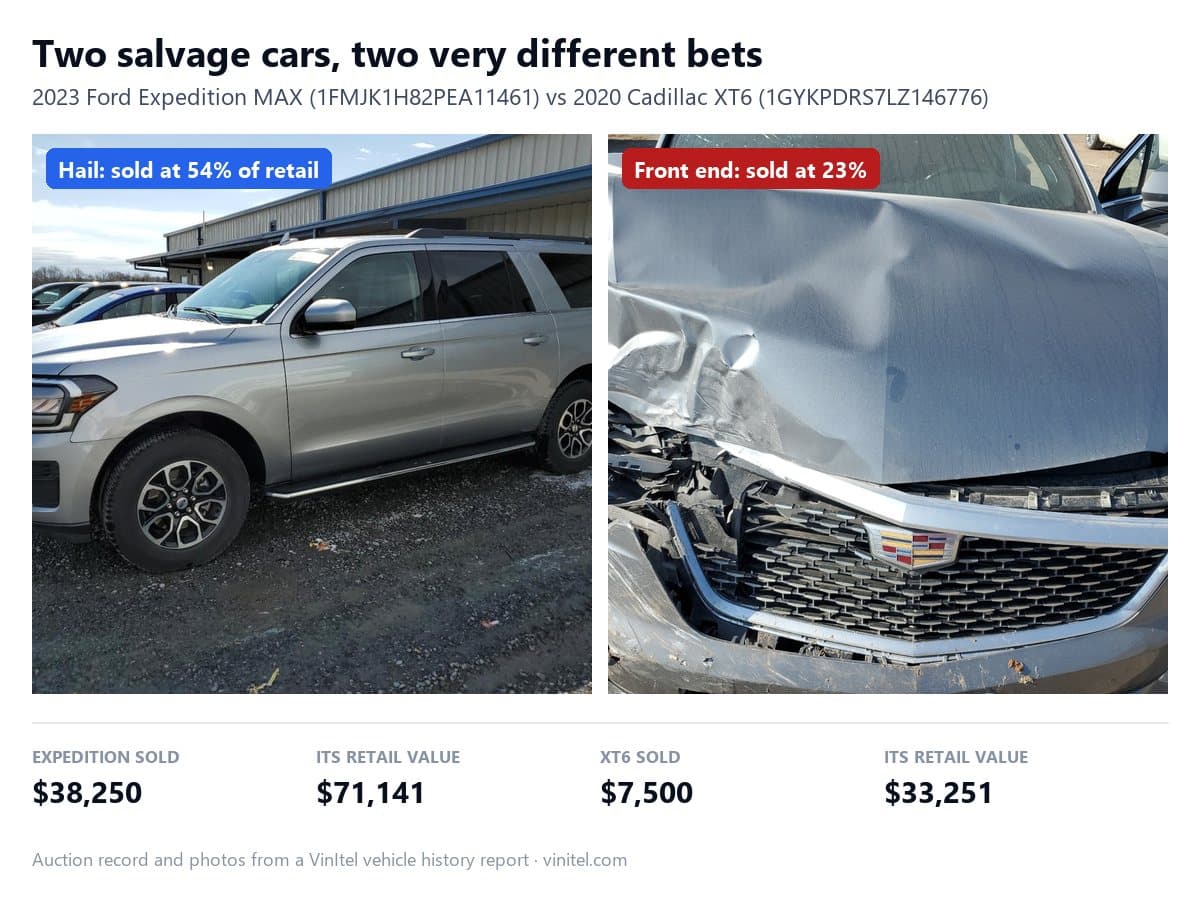
Two salvage cars, sold five months apart. A 2023 Ford Expedition MAX with hail damage, 25,753 miles, sold for $38,250 against a $71,141 retail value. That's 54%. A 2020 Cadillac XT6 with a crushed front end and deployed airbags sold for $7,500 against $33,251. That's 23%.
Both could come back as rebuilt titles. Both titles would say the same word. One is a big SUV with dents in the roof. The other had the part of the car that holds the radiator, the airbag sensors and the crash structure rebuilt. The buyers at the auction priced that difference. You should too.
The short answer
A rebuilt title car can be worth buying when the damage was cosmetic or minor, the repair was done well and documented, and the price reflects the brand. It's a bad buy when the damage was water, fire, a rollover or a hard front hit, or when you can't find out what the damage was.
What 7.5 million salvage sales say about damage
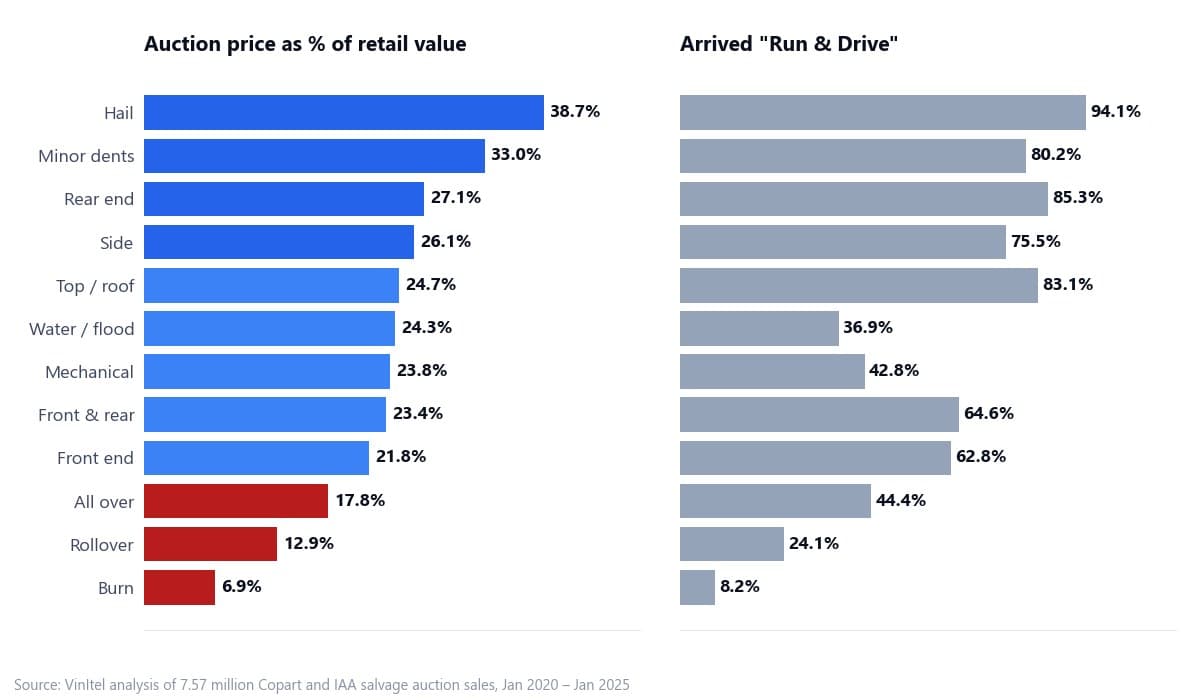
Salvage auction buyers are mostly rebuilders and dealers, people who repair cars for a living. What they pay, as a share of the car's retail value, is a good measure of how much repair they expect. We grouped 7.57 million sales by the damage the auction recorded.
| Primary damage | Price vs retail | Run & drive |
|---|---|---|
| Hail | 38.7% | 94.1% |
| Minor dents / scratches | 33.0% | 80.2% |
| Rear end | 27.1% | 85.3% |
| Side | 26.1% | 75.5% |
| Water / flood | 24.3% | 36.9% |
| Front end | 21.8% | 62.8% |
| All over | 17.8% | 44.4% |
| Rollover | 12.9% | 24.1% |
| Burn | 6.9% | 8.2% |
Three things stand out:
- Hail is in a class of its own. Hail cars sold for 38.7% of retail and 94.1% drove. A hail car is a dented car, and dents can be pulled or panels replaced without touching the structure.
- Flood looks better than it is. At 24.3% of retail, flood cars sold for more than front-end crash cars. But only 36.9% could run and drive, and the damage is in the wiring. See how to check for flood damage.
- Fire and rollovers are parts cars. Burned cars sold for 6.9% of retail and 8.2% could move under their own power.
How to check a rebuilt title car before you buy
- Look up the auction record. Run the VIN and find the salvage sale: the damage code, secondary damage, whether it ran, and the auction photos. The photos show the car before anyone fixed it.
- Ask for the repair invoice and parts receipts. A proper rebuild has them. New OEM airbags, a new radiator support, frame straightening on a measuring bench: these should all be on paper.
- Get the state inspection record. Most states inspect a car before issuing a rebuilt title. Ask the seller for it.
- Pay for a body shop inspection. Show them the auction photos so they know where to look. Ask them to scan the airbag system and check frame measurements.
- Call your insurer with the VIN. Find out what coverage you can get before you pay.
- Negotiate on the brand. Price it against the same car with a clean title, minus a real discount, because you'll get less when you sell it too.
Who should buy one
Good fit
- You plan to keep the car for years, so the resale discount matters less.
- The damage was hail, cosmetic or a light rear hit, and you've seen the auction photos.
- The seller has the repair paperwork and the price reflects the brand.
Walk away
- The damage was flood, fire, rollover or all over.
- Airbags deployed and there's no record of OEM replacement.
- The seller can't or won't tell you what happened, or the price is close to a clean-title car.
Questions buyers ask
What is the difference between a salvage and a rebuilt title?
A salvage title means an insurer or the state declared the car a total loss. It usually can't be registered for the road. A rebuilt (or reconstructed) title is issued after the car is repaired and passes the state's inspection, so it can be driven again. The brand stays on the title for good.
How much less is a rebuilt title car worth?
Dealers and appraisers typically value a rebuilt car well below the same car with a clean title, often 20% to 40% less, and it stays harder to sell. That discount is fair for a well-repaired car and too small for a badly repaired one, which is why the damage type matters so much.
Which damage types are safest to buy rebuilt?
Cosmetic damage: hail, minor dents and scratches, and light rear-end hits. In VinItel's records, 94.1% of hail cars and 85.3% of rear-end cars arrived at auction able to run and drive. Be careful with flood, fire, rollover and all-over damage, and with any front-end hit that deployed airbags or bent the frame.
Can I insure a rebuilt title car?
Usually, but check before you buy. Some insurers only offer liability coverage on rebuilt titles, some ask for an inspection or photos first, and a payout after a future crash is based on the lower rebuilt value. Call your insurer with the VIN.
How do I find out what the damage was on a rebuilt car?
Look up the VIN. If the car went through a salvage auction, the record shows the damage code, whether it ran, the sale price and photos of the car before it was repaired. That tells you far more than the word "rebuilt" on the title.
About the numbers
Based on 7,567,422 salvage auction sales at Copart and IAA in VinItel's records from January 2020 to January 2025, grouped by the primary damage the auction recorded. "Price vs retail" averages sale price divided by the auction's estimated retail value, only for sales where both were recorded (mostly 2024 and 2025). "Run & drive" is the share of sales with a recorded condition that were marked Run & Drive. For what each title brand means, see title brands explained.
- #rebuilt title
- #salvage title
- #hail damage
- #flood car
- #salvage auction prices
- #car insurance
- #VIN check
- #auction photos