How to Check if a Car Was Flooded (Before It Costs You)
A flood car can look brand new. Here is how to catch one by VIN and in person, with our numbers on 194,296 flood cars sold at US salvage auctions.
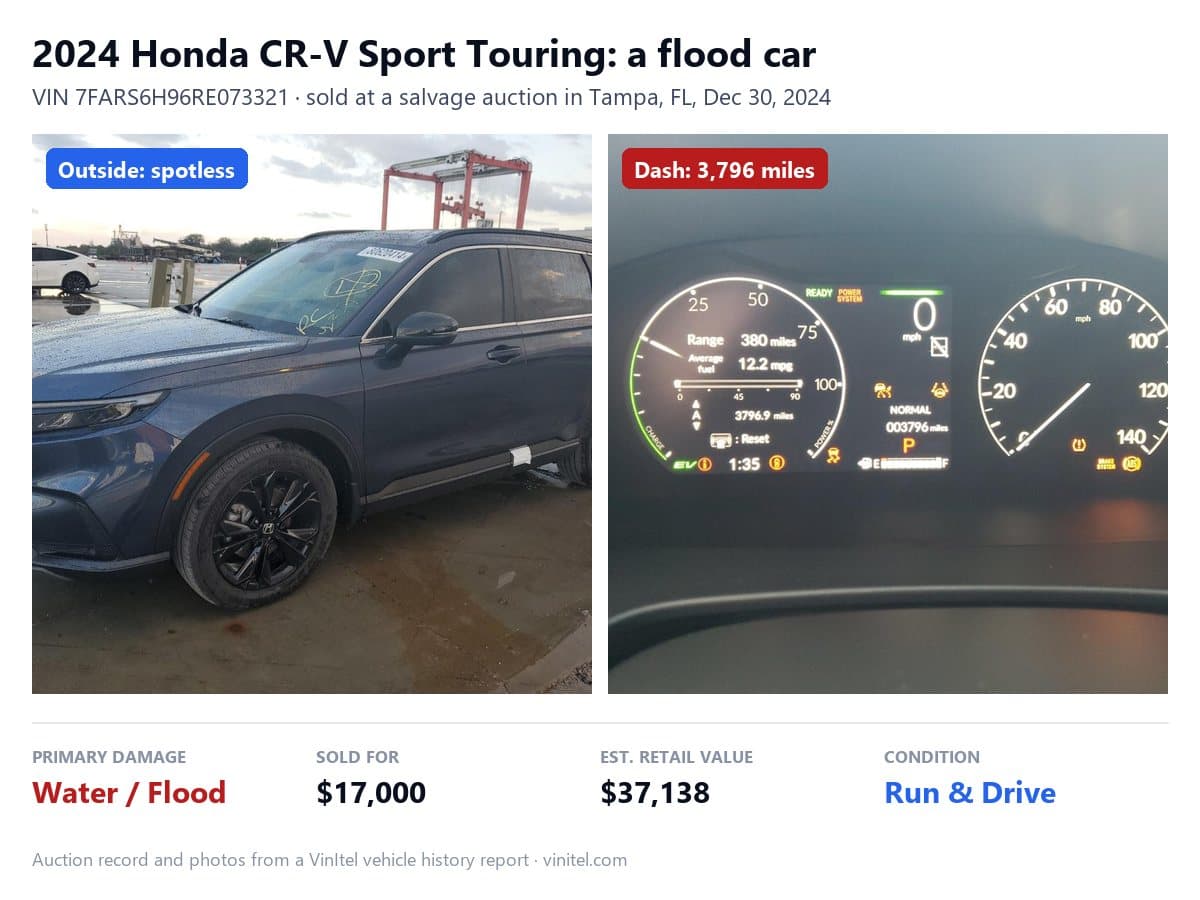
The 2024 Honda CR-V below has 3,796 miles on it. The paint is perfect, the leather is clean and it starts and drives. On December 30, 2024 it sold at a salvage auction in Tampa for $17,000, less than half of its $37,138 retail value. The damage code on the auction record: Water/Flood.
That's the problem with flood cars. Crash damage shows. Water damage hides in wiring, connectors and control modules, and shows up months later as warning lights, dead windows and an airbag system that may not fire. If the car gets a fresh carpet and a detail, the next buyer sees a nearly new SUV.
How many flood cars are out there
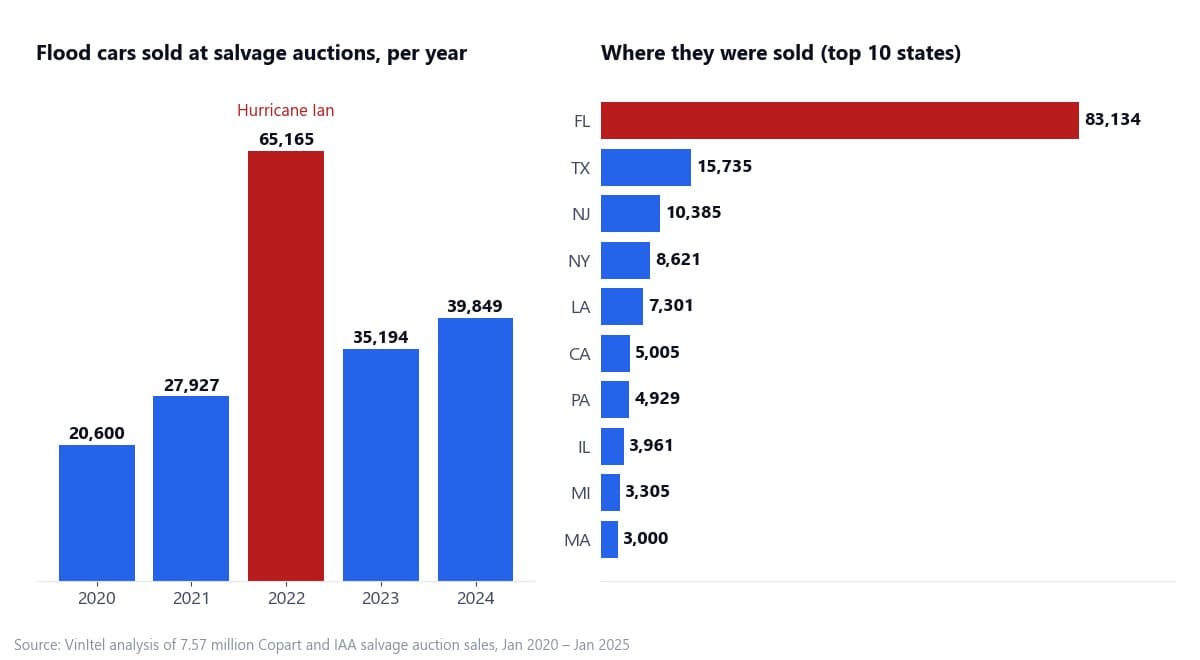
We counted every salvage auction sale in VinItel's records from January 2020 to January 2025: 7.57 million sales at Copart and IAA. 194,296 of them had water or flood as the primary damage.
- Florida sold 83,134 of them, about 43%. Texas was a distant second with 15,735, then New Jersey, New York and Louisiana.
- Storm years spike. 2022 saw 65,165 flood sales, more than twice 2021. That was the year Hurricane Ian flooded southwest Florida.
- Most can't drive away.Only 36.9% of flood cars arrived at auction marked "Run & Drive", against 85.3% of rear-end crash cars.
- They sell cheap. Where the auction recorded a retail value, flood cars sold for 24.3% of it on average.
Cheap cars with a nice exterior get bought, repaired and resold. Some of them get a new title in another state. That's how a car that sat in Tampa floodwater ends up on a lot in Ohio with a clean title and a story about one careful owner.
Step 1: Check the VIN before you see the car
A flood car that went through an insurance claim leaves a paper trail. You want three things from a VIN check:
- Salvage auction records. An auction sale with "Water/Flood" as the primary damage is the clearest sign there is. Look at the sale date and location too: a sale in Florida, Texas or Louisiana in the weeks after a hurricane tells its own story.
- Title brands, in every state. Flood, salvage, junk or "water damage" brands. Read the whole title history, not just the latest title. A brand in one state followed by a clean title in another is a red flag.
- Total loss records. Insurers report total losses. A total loss with no crash on record is often water.
Our free VIN check tells you whether any of these exist. The full report shows the auction lot, damage code, sale price and the auction photos, which are the best evidence of all: they show the car before anyone cleaned it. You can also look up salvage auction photos by VIN on their own.
Step 2: Inspect it like a flood car
You don't need tools for most of this. Bring a flashlight and do it in daylight.
Smell and carpet
- Close the doors and windows for a minute, then breathe in. Musty or mildew is bad. A wall of air freshener is suspicious.
- Press the carpet hard in the footwells and the trunk. Damp underneath is a deal breaker.
- Pull up a corner of the carpet or the trunk mat. Look for silt, sand, a tide line or brand-new padding in an older car.
Metal that shouldn't rust
- Seat rails and seat mounting bolts. They are bare metal and rust fast after a soak.
- Screw heads under the dashboard and in the door jambs.
- The spare-tire well. Water collects there and leaves rust and mud.
Electrics
- Turn the key to on and watch every warning light come on and go off. A missing airbag light can mean a bulb was pulled.
- Try every window, lock, seat motor, mirror, light, the radio, the screen and the USB ports.
- Look for fog or water lines inside the headlights and tail lights.
Under the hood and under the car
- Mud or debris in odd places: behind the radiator, in the air filter box, on top of the fuel tank.
- Corrosion on connectors and the fuse box. Green or white crust is a bad sign.
- Engine oil that looks milky means water got into the engine.
Buying after a hurricane season
Flood cars move. In the months after a big storm, insurers send tens of thousands of cars to auction at once, and buyers ship them all over the country. If you're buying a used car in the spring after a hurricane season, check where the car was registered and sold in the previous six months. A car that was in Florida, Texas or Louisiana last fall and is now for sale far away with a fresh title deserves a full report and an inspection.
If you already bought one
- Get the full history report and save it. It is your evidence of what the record showed.
- Have a mechanic document the flood damage in writing, with photos.
- If a dealer sold it to you without disclosing a flood brand or an auction record they had, talk to your state attorney general's consumer office or a lawyer. Many states require dealers to disclose branded titles.
Questions buyers ask
Can you tell if a car was flooded from the VIN?
Often, yes. If an insurer paid out the car as a flood loss, it usually goes to a salvage auction with "Water/Flood" as the primary damage, and many states then brand the title as flood or salvage. A VIN history report that includes auction records shows that sale, the damage code and the auction photos. A car that flooded without an insurance claim leaves no record, which is why you still need to inspect it.
Will a flooded car always have a flood or salvage title?
No. Title brands depend on the state, and a car can be retitled in a state that doesn't carry the original brand forward. In our data, flood cars were sold at auction in every region of the country, and flood cars move across state lines after big storms. Check the auction history, not just the title in the seller's hand.
How many flood cars are there?
VinItel's records show 194,296 salvage auction sales with water or flood as the primary damage between January 2020 and January 2025. 83,134 of them, about 43%, were sold in Florida. 2022 was the peak year with 65,165, the year Hurricane Ian hit Florida.
Is a flood car ever worth buying?
Rarely as a daily driver. Water reaches wiring, connectors, control modules, airbag sensors and seat motors, and corrosion keeps working for months after the car looks dry. Flood cars sold at auction for 24.3% of their retail value on average, and only 36.9% arrived able to run and drive. If you buy one, buy it priced as a project and get the electrical system checked.
What does a flood car smell like?
Musty, like a damp basement, or heavily perfumed to cover that. A strong air freshener in a used car on a lot is a reason to pull up a corner of the carpet.
About the numbers
Counts come from 7,567,422 salvage auction sales at Copart and IAA in VinItel's records, January 2020 to January 2025, grouped by the primary damage the auction recorded. States come from the auction location. Price as a share of retail uses only sales where the auction recorded a retail value, mostly 2024 and 2025. More of our data: which rebuilt cars are worth buying and the signs a car was in an accident.
- #flood car
- #flood damage
- #VIN check
- #salvage auction
- #hurricane cars
- #Florida
- #title brands
- #used car inspection