How to Check for Odometer Rollback (and Tell It From a Typo)
A drop in a car's mileage history can mean fraud, or a clerk who hit a key twice. Two real VINs show the difference, and our data shows which cars carry the most risk.
Rolling back an odometer is one of the oldest used-car tricks, and digital dashboards didn't end it. A 100,000-mile car sold as a 40,000-mile car can be worth thousands more, and the buyer pays for it twice: once at the sale and again when the worn parts fail early.
The odometer can be changed. The history can't. Every inspection, title transfer, service visit and auction records a mileage reading, and those readings are what give a rollback away. But they're typed in by people, so you also need to know what a simple typo looks like.
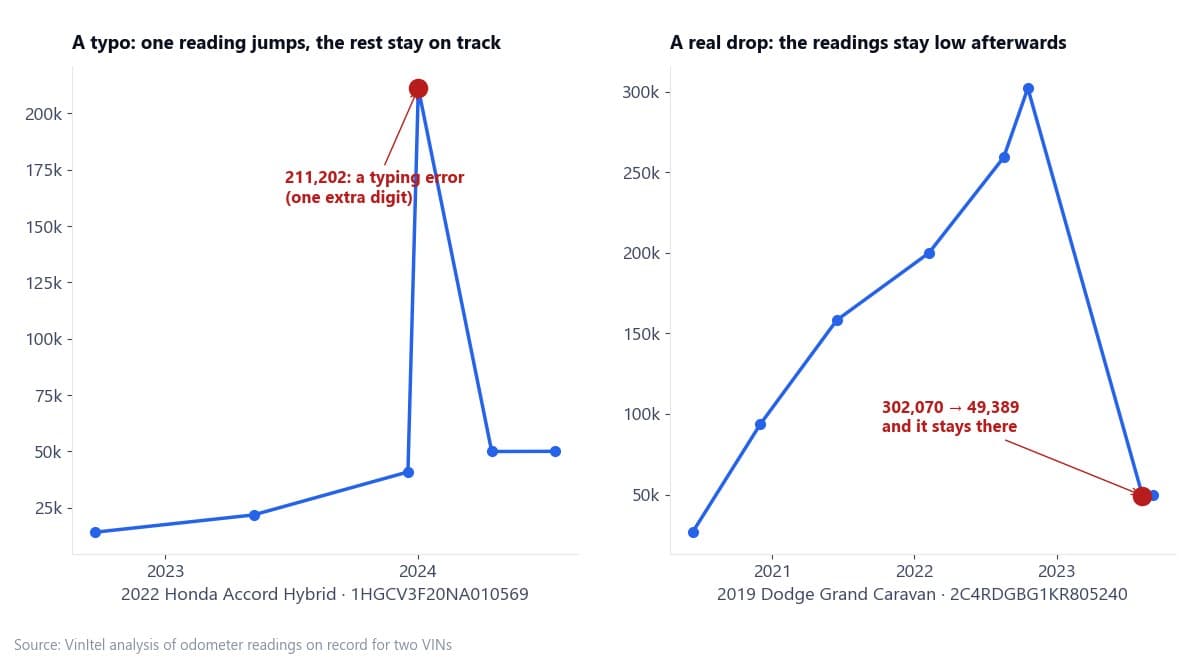
A typo: one reading jumps, then the line goes on
The 2022 Honda Accord Hybrid on the left (VIN 1HGCV3F20NA010569) climbs normally: 14,172 miles, 21,838, 40,910. On January 2, 2024 one record says 211,202. Three months later it reads 49,985, then 50,060. The odd reading is 21,120 with an extra digit, give or take. The car never had 211,000 miles.
We see this pattern all the time. A 2021 GMC Sierra Denali reads 18,671, then 266,646, then 26,646 ten days later: someone typed one 6 twice. A 2018 Cadillac ATS has a reading of exactly 333,333, a placeholder somebody keyed in.
A real drop: the readings stay low
The 2019 Dodge Grand Caravan on the right (VIN 2C4RDGBG1KR805240) piled up miles fast, the way a work van does: 93,779 by December 2020, 199,831 by February 2022, 302,070 by October 2022. The next reading, in August 2023, is 49,389. A month later, 49,616.
That's the shape to worry about. The later readings follow the low number, so whatever the dashboard says now, it isn't the 300,000-plus miles the van had already driven. A rollback and an undisclosed replacement cluster look the same on paper. Either way, the buyer deserves to be told.
Which cars carry the most risk
We looked at 16.1 million vehicles in our records and counted the ones with an odometer problem on file. Overall it's about 0.53%, roughly 1 car in 190. But it depends heavily on age.
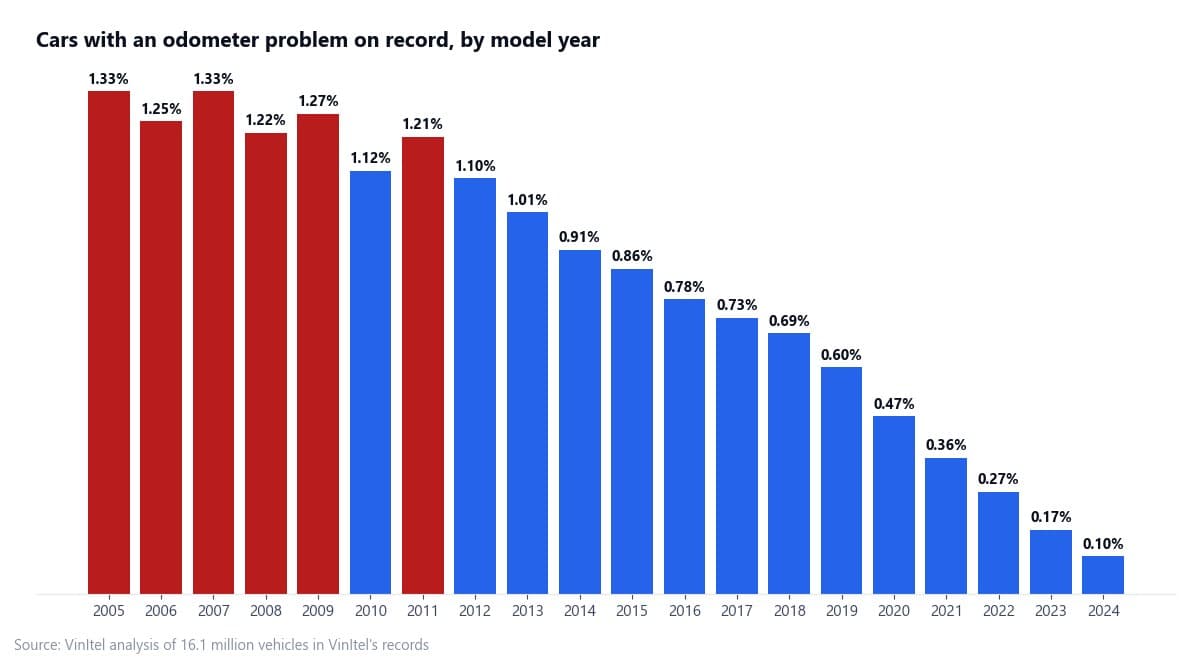
- 2005 to 2009 models: about 1.3%. More than ten times the rate of a 2024 car.
- 2015 to 2019 models: 0.6% to 0.9%. This is where most used-car buyers shop.
- By brand, the spread is small. Dodge and Ford sit at about 0.68%, Nissan and Audi near 0.47%. The car's age and history matter far more than the badge.
The five-minute check
- Photograph the dashboard with the car running, so the mileage and any warning lights are on record.
- Pull the mileage history by VIN. Look for any reading higher than today's. Then check whether it's a lone spike (typo) or a drop the later readings follow (problem).
- Match the wear to the miles. A shiny brake pedal, a worn steering wheel or a flattened driver's seat bolster on a "40,000-mile" car don't add up.
- Check the paperwork. Oil-change stickers, service invoices and inspection slips all carry mileage. They should line up with the dashboard.
- Look at the title. Titles carry an odometer status. "Not actual" or "exceeds mechanical limits" means the mileage can't be trusted, whatever the dash says.
Questions buyers ask
Can digital odometers be rolled back?
Yes. Tools that rewrite the mileage stored in a digital cluster are sold openly, and the job takes minutes. Digital doesn't mean tamper-proof. The mileage history recorded at inspections, title transfers and service visits is what gives a rollback away.
How can I tell if a car's mileage was rolled back?
Compare the number on the dashboard with the readings on record. If the history shows higher mileage in the past than the car shows today, and the later readings stay low, the odometer was changed or replaced. Then check the physical wear: pedals, steering wheel, driver's seat bolster and the shift knob should match the mileage.
Is every mileage drop on a report a rollback?
No. Readings are typed in by people at DMVs, shops and auctions, and typos happen: an extra digit, a missing digit, a placeholder like 333333. A single reading that jumps and then returns to the normal line is usually a typo. A drop that the later readings follow is the pattern to worry about.
Which cars are most likely to have an odometer problem?
Older ones. In our records, 1.2% to 1.3% of 2005 to 2009 models have an odometer problem on file, against 0.10% of 2024 models. Older cars have had more owners and more chances for a rollback or a cluster swap.
About the numbers
Rates come from 16.1 million vehicles in VinItel's records, counting vehicles with an odometer problem flagged in their history. Readings for the two example VINs are the odometer records on file, in date order. A flag means the mileage history has a problem, not that a specific person rolled the odometer back. More: how title washing works and how to read a VIN report.
- #odometer rollback
- #odometer fraud
- #mileage check
- #VIN check
- #used car inspection
- #digital odometer
- #title history