BidFax Alternatives: Where to Find Copart and IAA Sold Prices in 2026
BidFax and sites like it keep Copart and IAA listings online after the sale. Here's what they can and can't tell you, and where to get the sold price by VIN.
Copart and IAA sell well over two million damaged cars a year. While a car is up for sale, anyone can see its photos and damage. Once the auction ends, the listing drops out of public view, and the final bid is shown to members. That gap is why people search for BidFax: they want to see what happened to a car after the sale, usually because the same car is now for sale with a fresh coat of paint.
What auction archive sites do
BidFax and similar sites copy Copart and IAA listings and keep them online, searchable by VIN or lot number. Depending on the site and the lot, you'll find the auction photos, the damage, the odometer, the sale date and sometimes the final bid. They're useful for one question: was this car ever sold at a salvage auction?
They have limits worth knowing before you rely on one:
- The price is often missing. Some archives capture the listing before the sale and never record the winning bid, or show $0 for lots sold on approval.
- A bid without context misleads. $3,000 is a bargain for a running RAV4 and a lot of money for a stationary Ford Focus. Without the pre-damage value you can't tell which.
- It's one event, not the car's history. An archive shows the auction. It doesn't show the title brands before and after, the accident reports or the odometer readings.
- Quality varies. Many archive sites are run anonymously, carry heavy advertising and change domains often. Check the VIN on the page matches the car in front of you.
Your options, in order
- Copart or IAA themselves. Members can see final bids, and both show live and upcoming lots. Useful if you're bidding; not much help for a car sold months ago.
- A free auction archive. Good for a quick look at photos and damage. Treat the price as a hint and confirm the VIN.
- VinItel's free price tool. Our salvage auction price tool shows what cars like yours sold for, by model, year, damage and condition, from 2.2 million real Copart and IAA sales. No VIN needed.
- A VIN report with the auction records. Run the VIN for free to see whether Copart or IAA sale records exist. The $8.99 report lists every sale with the winning bid, sale date, the insurer's pre-damage value and repair estimate where listed, damage, condition, odometer and the auction photos, next to the title history, accidents and odometer readings.
What a useful sold-price record shows
Whatever site you use, check the record has these:
| Field | Why it matters |
|---|---|
| Winning bid and sale date | The price only means something with a date |
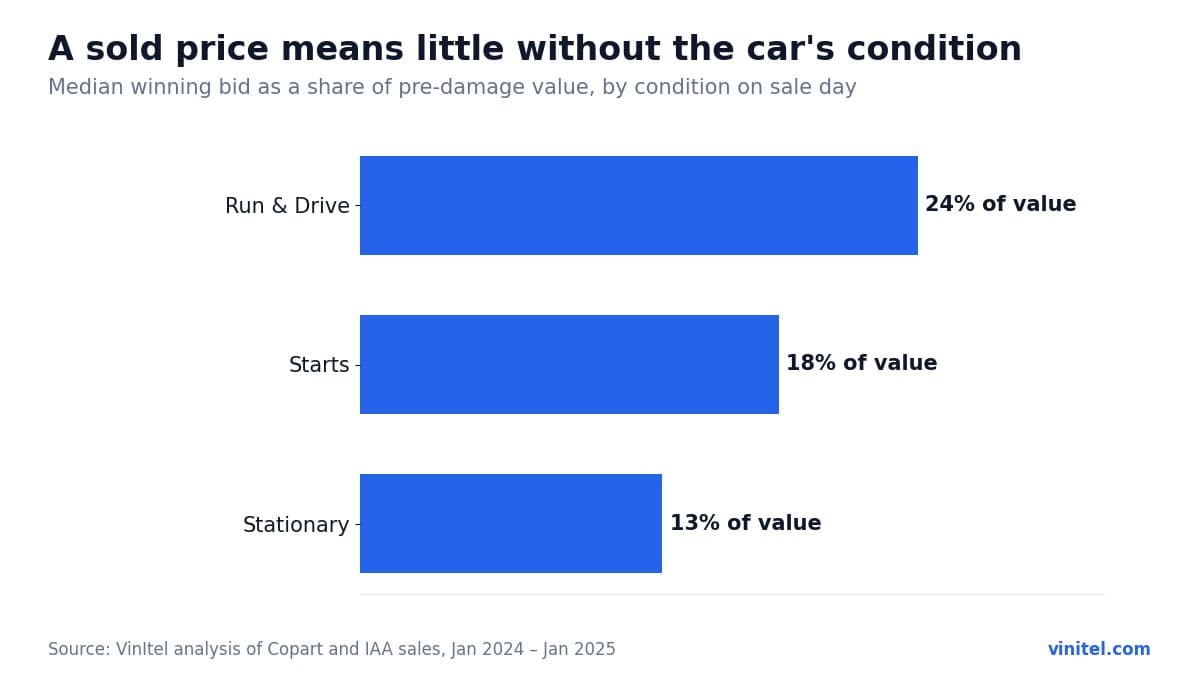
| Damage and condition | Run & Drive vs Stationary changes the price by half |
| Pre-damage value | Turns a bid into a share of what the car was worth |
| Repair estimate | Shows how big the job was before the rebuild |
| Every sale of the VIN | Some cars go through auction more than once |
| Title history | Whether the salvage brand followed the car afterwards |
How to read a sold price
The median car at Copart and IAA sold for $2,425, about 21% of its pre-damage value. Running cars sold for 24% of value, stationary ones for 13%. Hail cars went for 39%, burned cars for 4%. So before you call a price high or low, compare it with cars of the same model, age, damage and condition. We broke all of that down in what salvage cars really sell for.
Questions people ask
What is BidFax?
BidFax is one of several websites that archive Copart and IAA auction listings, so a car's lot, photos and auction details can still be found after the sale ends and the auction takes the listing down. People mostly use it to check whether a used car was once sold at a salvage auction.
Is there a free alternative to BidFax?
Yes. Several archive sites show Copart and IAA lots for free, and VinItel's free salvage auction price tool shows what cars like yours sold for by model, year, damage and condition. For one specific car, VinItel's free VIN check says whether Copart or IAA sale records exist; the full $8.99 report shows each sale.
Can I see a Copart sold price after the auction ends?
Not on Copart's public site: once a lot closes it drops out of public search, and final bids are shown to members. Archive sites and history reports keep the sale record tied to the VIN. VinItel holds the winning bid for 99.6% of its auction records.
Why does an auction archive show $0 or no price?
Some lots sell on minimum bid or on approval, some are cancelled or relisted, and some archives copy the listing before the sale and never capture the final bid. Treat a missing or $0 price as unknown, not as a giveaway.
What should a good sold-price record include?
The sale date, winning bid, primary and secondary damage, condition on sale day (Run & Drive, Starts or Stationary), odometer and its status, title document, and ideally the insurer's pre-damage value and repair estimate, plus the auction photos.
About the numbers
Prices come from Copart and IAA sales dated January 2024 to January 2025 in VinItel's auction records. Share of value is the winning bid divided by the insurer's actual cash value where the auction listed one. VinItel is not affiliated with Copart, IAA or any auction archive site.
- #BidFax
- #Copart sold prices
- #IAA sold prices
- #auction history
- #salvage auction
- #VIN lookup